
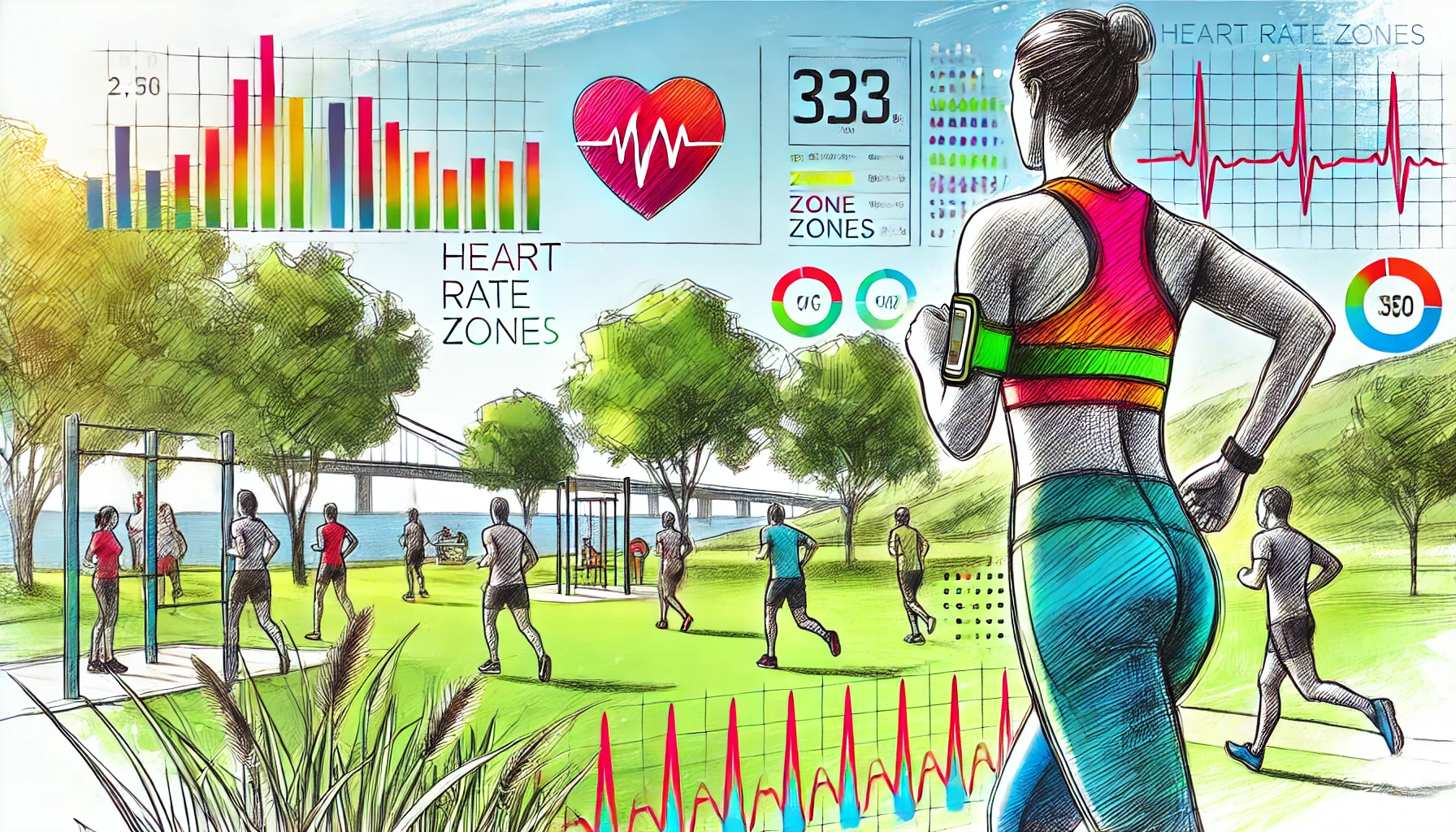
Heart rate zones are a valuable tool for optimizing your workouts and achieving your fitness goals. By understanding and utilizing these zones, you can tailor your exercise intensity to match your desired outcomes, whether it’s improving cardiovascular health, burning fat, or enhancing athletic performance. This guide will explain how to calculate your heart rate zones and how to use them for effective workouts.
Understanding Heart Rate Zones
Heart rate zones are ranges of beats per minute (bpm) that correspond to different levels of exercise intensity. These zones are typically divided into five categories, each offering distinct benefits for fitness and health:
- Zone 1: Very Light (50-60% of Maximum Heart Rate)
- Purpose: Recovery, warm-up, and cool-down
- Benefits: Improves overall health, aids recovery, and promotes relaxation
- Zone 2: Light (60-70% of Maximum Heart Rate)
- Purpose: Fat burning, endurance building
- Benefits: Enhances aerobic capacity, promotes fat burning, and builds basic endurance
- Zone 3: Moderate (70-80% of Maximum Heart Rate)
- Purpose: Improved cardiovascular fitness, weight management
- Benefits: Increases aerobic fitness, improves heart and lung capacity, aids in weight loss
- Zone 4: Hard (80-90% of Maximum Heart Rate)
- Purpose: Enhanced aerobic and anaerobic capacity, speed training
- Benefits: Improves VO2 max, increases anaerobic threshold, boosts speed and power
- Zone 5: Maximum (90-100% of Maximum Heart Rate)
- Purpose: Peak performance, high-intensity training
- Benefits: Maximizes calorie burn, enhances sprint performance, builds power
Calculating Your Maximum Heart Rate (MHR)
To use heart rate zones effectively, you first need to determine your maximum heart rate (MHR). A common method is the age-based formula:
- MHR = 220 – your age
For example, if you are 30 years old:
- MHR = 220 – 30 = 190 bpm
Determining Your Heart Rate Zones
Once you know your MHR, calculate your heart rate zones as follows:
- Zone 1: Very Light
- 50-60% of MHR: MHR×0.50\text{MHR} \times 0.50 to MHR×0.60\text{MHR} \times 0.60
- For a 30-year-old: 95-114 bpm
- Zone 2: Light
- 60-70% of MHR: MHR×0.60\text{MHR} \times 0.60 to MHR×0.70\text{MHR} \times 0.70
- For a 30-year-old: 114-133 bpm
- Zone 3: Moderate
- 70-80% of MHR: MHR×0.70\text{MHR} \times 0.70 to MHR×0.80\text{MHR} \times 0.80
- For a 30-year-old: 133-152 bpm
- Zone 4: Hard
- 80-90% of MHR: MHR×0.80\text{MHR} \times 0.80 to MHR×0.90\text{MHR} \times 0.90
- For a 30-year-old: 152-171 bpm
- Zone 5: Maximum
- 90-100% of MHR: MHR×0.90\text{MHR} \times 0.90 to MHR×1.00\text{MHR} \times 1.00
- For a 30-year-old: 171-190 bpm
Using Heart Rate Zones in Your Workouts
- Warm-Up and Cool-Down (Zone 1)
- Activities: Light jogging, walking, dynamic stretches
- Duration: 5-10 minutes at the beginning and end of your workout
- Purpose: Prepares your body for exercise, prevents injuries, aids in recovery
- Endurance Training (Zone 2)
- Activities: Steady-state cardio like jogging, cycling, swimming
- Duration: 30-60 minutes
- Purpose: Improves aerobic capacity, builds a solid cardiovascular base, promotes fat burning
- Aerobic Fitness (Zone 3)
- Activities: Running, brisk cycling, aerobic classes
- Duration: 20-40 minutes
- Purpose: Enhances cardiovascular fitness, increases stamina, aids in weight management
- Anaerobic and Speed Training (Zone 4)
- Activities: Interval training, hill sprints, high-intensity interval training (HIIT)
- Duration: 10-30 minutes (including intervals)
- Purpose: Improves speed, power, and anaerobic capacity, increases calorie burn
- High-Intensity Performance (Zone 5)
- Activities: Sprinting, high-intensity circuit training, competitive sports
- Duration: Short bursts of 1-5 minutes with longer rest periods
- Purpose: Builds peak performance, maximizes calorie expenditure, enhances athletic capabilities
Tips for Effective Heart Rate Zone Training
- Use a Heart Rate Monitor: Wear a heart rate monitor or use a fitness tracker to get accurate, real-time data.
- Listen to Your Body: Heart rate zones are guidelines. Pay attention to how you feel and adjust accordingly.
- Gradual Progression: Increase the intensity and duration of your workouts gradually to avoid injury and overtraining.
- Variety: Mix different types of workouts to target various heart rate zones and keep your routine engaging.
- Rest and Recovery: Incorporate rest days and lower-intensity workouts to allow your body to recover and adapt.
Conclusion
Understanding and using heart rate zones can significantly enhance the effectiveness of your workouts. By tailoring your exercise intensity to match your fitness goals, you can improve cardiovascular health, burn fat more efficiently, and boost your athletic performance. Whether you’re a beginner or an experienced athlete, incorporating heart rate zone training into your routine can lead to better health outcomes and a more enjoyable fitness journey.